About Our Parish
Rooted in the ancient traditions of the Maronite Church, serving our community in faith and love.
Saint John Maron
THE STORY BEGINS It was November 2,1903. Four distinguished gentlemen met in the City of Buffalo, New York. Their purpose was to formally create a Maronite Catholic parish. One of these men was the Bishop of Buffalo, Charles Colton. He was joined by Rev. Georges Aziz, a Lebanese priest. Fr. Aziz had brought with him two laymen, John Moses and Zakhia Ghanim. Together they represented a small community of Lebanese who had gathered in Buffalo over the years. They signed the legal papers that made St. John Maron one of the first ten Maronite parishes established in the United States. Thus was born a worship community unique in Buffalo. It immediately became the foundation and community center for the Lebanese in Western New York. The parish was named after St. John Maron, the first church in the United States dedicated to our first the first Maronite Patriarch of Antioch.
OVERVIEW St. John Maron parish quickly became and has remained the spiritual, cultural and social hub for the Lebanese of Western New York. Both the parish and the Lebanese people put down strong roots and became mainstays of the greater Buffalo community. St. John Maron's people have been blessed with the wisdom and guidance of a succession of gifted men who lovingly served as pastors of St. John Maron. It was not long before the influence of the parish was broadened throughout Western New York with missions for the Lebanese people residing in the cities of Niagara Falls and Olean. Soon Our Lady of Lebanon church was established in Niagara Falls as well as St. Joseph Church in Olean. These became autonomous parishes in 1914 and 1919 respectively. Msgr. Nemtallah Shemalie, who had been assisting his brother, Msgr. Francis Shemalie, pastor of St. John Maron, was named pastor of St. Joseph's. For several decades, then, St. John Maron grew from within through the depression and World War II, prospering along with the rest of the country from the Fifties through the Seventies. By the last quarter of the Twentieth Century, St. John Maron was a beacon to a new generation of Lebanese. Seeking peace and fresh opportunities, they came to the United States, many escaping the turmoil and suffering caused by the war in Lebanon. The people of St. John Maron have been enriched by the knowledge and contributions of those who have found their way to the parish, which continues to prosper and grow even as many other parishes in Western New York diminish or fail.
EARLY YEARS The first pastor of St. John Maron was Rev. Antoun A. Zoghby from 1903-1904, followed by Rev. Georges Aziz. In 1908 Fr. Aziz was succeeded by Rev. Francis Shemalie, who served the people of St. John Maron for over fifty years, until 1959. During Fr. Shemalie's pastorate St. John Maron opened the first Maronite school in the United States. Five years later the first graduation class of four was ready to take on the world. They encountered many challenges as World War I raged closer to its end. Fr. Shemalie was with them and their children through the hardships of the Great Depression and the trials of the Second World War. Through all those years Lebanese children were schooled there. Eventually, the school closed following the graduation of its last class in 1948. Fr. Shemalie arrived at St. John Maron when many of the Lebanese in Buffalo made their homes on what is known locally as "the Lower East Side". From Seneca Street the church moved, in 1919, to 41 Cedar Street, where it remained until 1960. By mid-century many Lebanese had relocated away from the old neighborhood. This flight of parishioners, combined with other pressures, - in part created by an urban redevelopment project affecting the whole of Buffalo's lower east side - caused the church to establish a temporary rectory at 6335 Main Street in Williamsville.
A NEW ADDRESS In 1954 the parish was elated to see its beloved pastor, Fr. Francis Shemalie, elevated to the rank of Chorbishop. After serving St. John Maron as pastor for more than fifty years, Msgr. Shemalie died in 1959. His passing marked the end of the first era in St. John Maron's history, an era defined by the parish's central role in its parishioners' lives and in their closely-knit neighborhood on Buffalo's east side. In the almost sixty years since the parish's inception, the Lebanese and Lebanese-Americans who made up its membership had grown, prospered and, in large part, had begun to disperse throughout the greater Buffalo community. Although now spread out, many had chosen to reside in the nearby suburban Town of Amherst and the seemingly still quaint Village of Williamsville within the town, which retained vestiges of the farming community it has been in the Nineteenth and early-Twentieth Centuries. After Msgr. Shemalie's death Fr. Paul Hage, his assistant, was appointed Administrator of the parish. The next year he presided over the move of the parish to temporary quarters on Main Street. Fr. Paul immediately began an active, tireless campaign to solicit support for acquiring property and developing plans to build a church at a new location. Already a prosperous suburb, in 1960 Williamsville still retained a slightly rural character. A barn located near the rectory served as St. John Maron's third church building. Nostalgically, the barnyard liturgies slipped into history after only a year. In 1960 Fr. Peter F. Sfeir, newly appointed Pastor, joined Fr. Hage in the ambitious task of planning the construction of, and the move to, the current church building nearby on Wehrle Drive where the generosity of Norman Joseph and Amelia Moran, prominent parishioners, provided the land the parish would need and, later, the parish center.
Fr. Sfeir made significant contributions to the organization and vitality of the parish, including re-organizing and developing the societies and the choir. With the active, capable assistance of Fr. Paul Hage he succeeded in involving the entire parish in these activities, as well as in the financial support by means of the building fund, bingo and rental of the parish center. During this decade, the primary physical plant of the current church was developed, commencing with the construction of the church building in 1960. The church itself is a sizable building, but was not originally ornate in materials of decor. The modest new house of worship was ready for use, and the first Qurbono (Mass) was celebrated in October of 1961. The Parish Center was completed in 1963. After the rectory was first occupied in 1967, the core of the parish's campus was rounded out with the building of the shrine dedicated to St. Sharbel. This addition was donated by Mrs. John P. Atwater and daughters, and Miss Amelia Moran, devoted benefactor of the parish.
In 1968 Fr. Sfeir retired due to failing health and Fr. Paul Hage left to assume a new assignment. In 1969, Fr. Joseph D. Joseph was appointed as Pastor. The first parishioner baptized at the church on Cedar street in 1921, Fr. Joe had honorably served the parish as an Assistant to Msgr. Francis Shemalie from 1954 to 1956. Fr. Joe's strength was in his pastoral mission and service to his people. During the 1970's, the Lebanese throughout the United States had their attention drawn to the difficulties of their families and friends who remained in Lebanon. As the war raged there, the people of St. John Maron proved to be among the most generous of contributors to their cause, sending food, clothing and funds to help victims of the fighting. A new wave of Lebanese immigration to the United States took place among those looking to escape the brutalities of war, and the community of Christian Lebanese in Buffalo grew from the addition of many who chose to make their homes here. Fr. Joe worked tirelessly to aid those coming to the United States and to Buffalo in particular, as well as those who remained in Lebanon.
From 1972 through 1979 Fr. Joe was ably assisted by a young priest visiting the United States to continue his education at the University of Buffalo, Fr. Fouad El-Hage. From 1968 to 1972 St. John Maron's was also tapped to be the community in which new music for the Maronite Church throughout the world would be developed and tried out by another young priest from Lebanon, Fr. Mansour Labaky. He came to the United States specifically to compose a hymnal for the Maronite Rite. Using Arabic, Syriac, English and transliteration he created a music ministry for Lebanese-Americans. We are proud to have served as a proving ground, working under his direction as he fine-tuned his compositions, which soon began to be used by the Maronite Church throughout the world. Due to Fr. Joe's wise and courageous leadership, the parish settled down to a typical parish routine during the 1970's and 1980's. Qurbonos, weddings, baptisms and funerals were celebrated; parish groups met and children received their instructions in religious education classes. The church compound changed little except for the addition of an Education Center for conducting religious education classes in 1985. In 1996, Fr. Georges El-Khalli was appointed pastor following Fr. Joseph's retirement.
PARISH ORGANIZATIONS The history of St. John Maron is embodied in the men and women who have devoted themselves to service of their fellow parishioners and their church as expressed in ministry and service groups. Two of the oldest and most closely followed traditions of the parish are the Altar and Rosary Society and the Holy Name Society. These groups were founded in the early years of the parish. Among other such traditions are the Four Star Post, the Maronite Youth Organization, and the Maronite Young Adult Organization. Ministries such as serving as acolytes, ushers, members of the music ministry and lectors all have been beloved acts of service regularly practiced by many parishioner. Created in 1980, the Order of St. Sharbel was established by the Eparchy of St. Maron as a means of recognizing those whose generosity supports the retired clergy and the Maronite seminary in Washington, D.C. A significant number of parishioners of St. John Maron Parish are members of the Order of St. Sharbel. The Home-School Association, composed of parents, is an important ministry devoted to religious education in our parish. In 2016, St. John Maron Knights of Columbus Council 16441 was established and was our newest addition to our parish organization. After serving the parish for fourteen years, on June 1, 2010, Fr. Georges El-Khalli was transferred to Our Lady of the Cedars of Lebanon in Jamaica Plain, MA. Fr. Elie G. Kairouz was appointed as Pastor of St. John Maron Church until August 2024 then he was transferred to Saint John Paul II Church in Sleepy Hollow Westchester – NY and Fr. Dany A. Akar was appointed the new Pastor and under Fr. Akar' careful guidance, leadership and work ethic, St. John Maron Church is undergoing a new revitalization and looking forward to the continuing growth of our parish. From its inception, through the years, and up to the present, St. John Maron Parish has been a warm, welcoming home to Maronites in Western New York and to many other faithful worshipers. Growth, development and modernization have been constant traits of what always has remained a strong, positive entity in the local community and in the religious milieu of our parish family.
The following Pastors along with numerous devoted and loyal assistants served the faith community of St. John Maron with distinction: Rev. Antoun A. Zoghby (1903-1904) Rev. George Aziz(1904-1908) Rev. Msgr. Francis Shemalie(1908-1959) Rev. Peter Sfeir(1959-1968) Rev. Maroun Abi Nader(1968-1969) Rev. Msgr. Joseph D. Joseph(1969-1996) Rev. Georges Y. El-Khalli (1996-2010) Rev. Elie G. Kairouz (2010 – 2024) Rev. Dany A. Akar (2024 – Present)
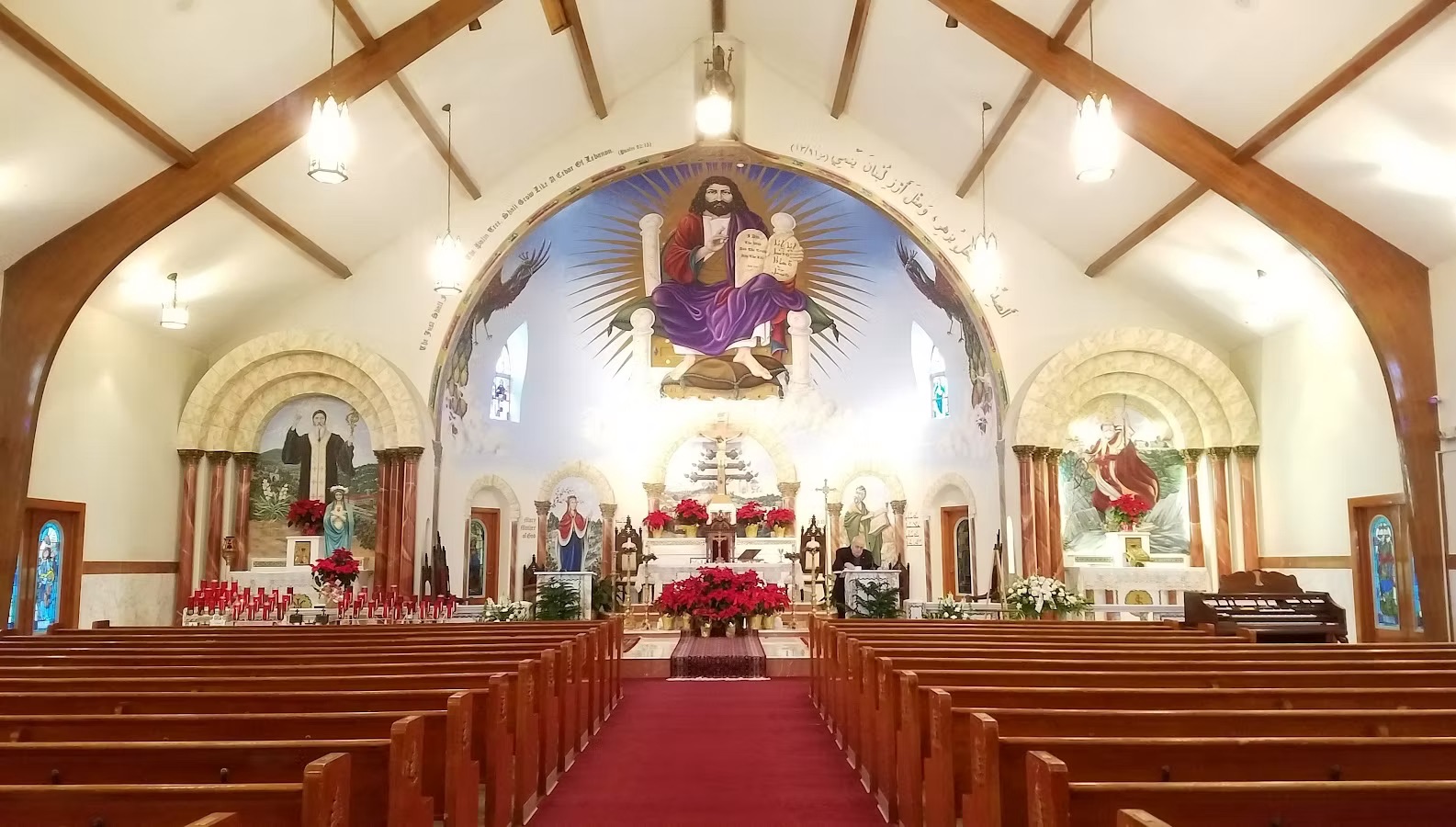
Maronite History
The Maronite Church takes its name from Saint Maron, a 4th-century Syrian monk whose holiness and miracles attracted many followers. After his death, his disciples established a monastery that became the spiritual center of the Maronite community.
Today, the Maronite Church is one of 23 Eastern Catholic Churches in full communion with Rome, with over 3 million faithful worldwide. Our parish continues to celebrate the Divine Liturgy according to the ancient Antiochene tradition, incorporating Syriac—the language spoken by Jesus—alongside English and Arabic.
The Maronite Tradition
A unique expression of Catholic faith rooted in the spirituality of the East
Sacred Tradition
We preserve and celebrate the ancient liturgical traditions of the Maronite Church, including the use of Syriac—the language of our Lord.
Community
We are a family united by faith, welcoming all who seek to grow closer to Christ in the warmth of our parish community.
Faith Formation
We are committed to lifelong learning and spiritual growth through religious education for all ages.
Service
Following Christ's example, we reach out in love to those in need through charitable works and community service.
Our Clergy & Parish Staff
Dedicated servants guiding our parish community in faith
Father Dany Akar
Pastor
(716) 634-0669Father Dany has served parishes for over 15 years, bringing a deep love for the Maronite tradition and pastoral care to our community.
Debbie Tartick
Administrative Assistant
(716) 634-0669Debbie Tartick is the Administrative Assistant proudly serving St. John Maron Church for over 30 years.
Bo Joude
Music Director
(716) 634-0669Bo leads our parish choir in the beautiful tradition of Maronite chants.
Parish Statistics
1904
Year Founded
500+
Families
15+
Ministries
102
Years of Service